
Bausch Lomb Tripod Magnifier
Status: Available for Loan Consideration for exhibition, institutional study, research on optical instruments and scientific education, or approved placement.
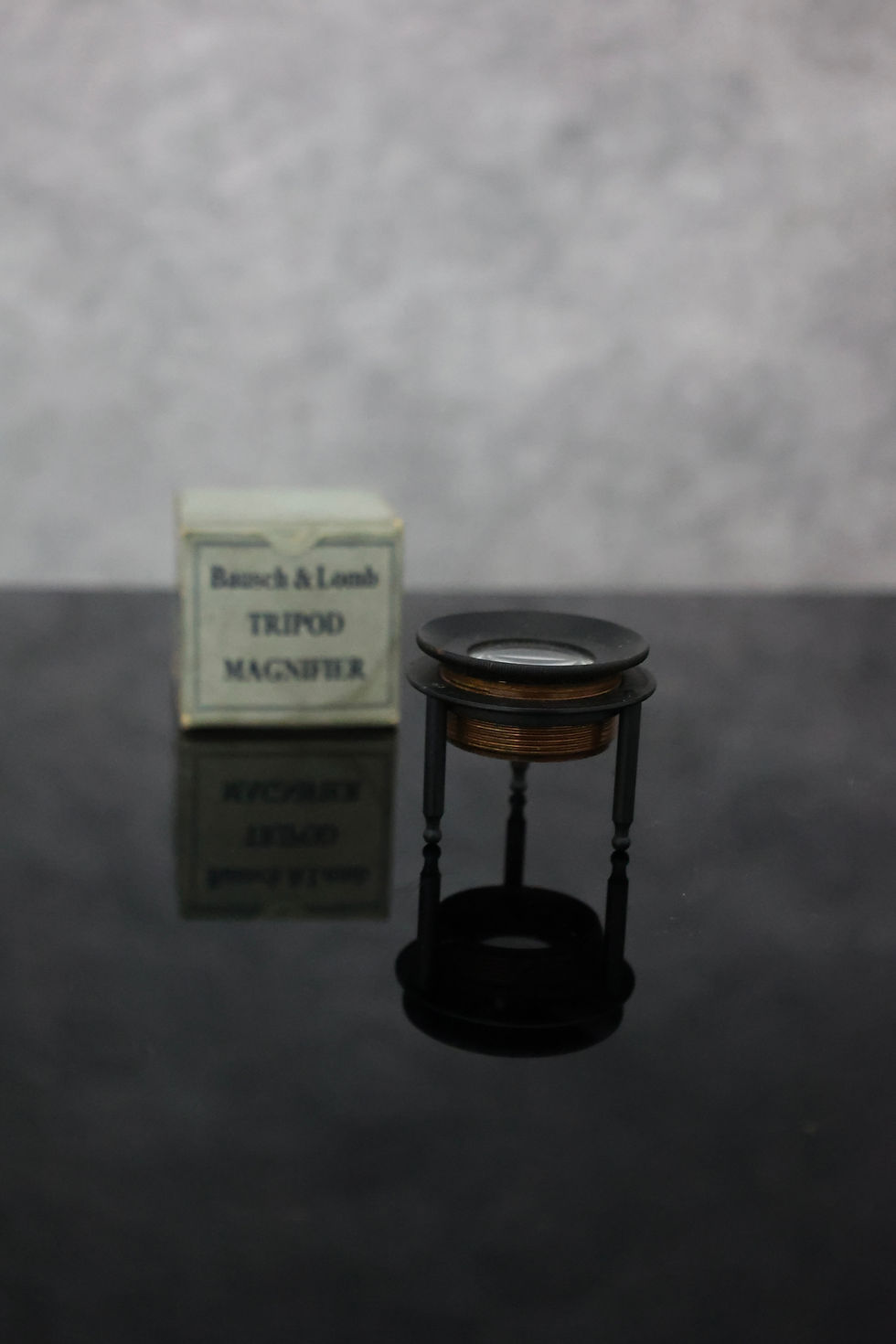
Bausch & Lomb Tripod Magnifier
United States: Rochester, New York
c. 1930-1940s
Object Description and Dating
This object is a tripod magnifier manufactured by Bausch & Lomb, an American optical company central to the development of precision lenses and scientific instruments in the late 19th and early 20th centuries. The magnifier consists of a circular glass lens mounted within a metal housing, supported by three vertical legs that elevate it to a fixed focal height above the viewing surface.
The construction reflects standardized industrial production, with a balance between durability and portability. The tripod form allows the lens to remain stable during use, distinguishing it from handheld magnifiers and aligning it with tools intended for sustained, repetitive inspection work.
The original box clearly dates this object to the 1930s–1940s, based on its typography, layout, and branding style. The serif typeface, restrained composition, and circular emblem are characteristic of interwar and early mid-century American industrial packaging, where clarity, authority, and scientific legitimacy were emphasized over ornamentation. This period marks a transition toward more modern, simplified branding while still retaining traditional typographic structures.
Function and Use
Tripod magnifiers were designed for hands-free magnification, enabling users to closely examine small objects or printed materials while maintaining consistent focus. By fixing the distance between the lens and the subject, the device reduced visual strain and allowed for more precise observation.
These tools were widely used across both professional and domestic environments. Jewelers, watchmakers, printers, and clerical workers relied on them for detailed inspection, while they were also used in offices and homes for reading fine print or examining documents. Their stability made them particularly valuable in situations where both hands were required for manipulation or analysis.
Within a broader system, this object belongs to a network of tools that supported visual precision and inspection during a period of increasing industrial complexity. As manufacturing processes and printed materials became more intricate, devices like this enabled users to engage with fine detail in a controlled and repeatable way.
Boxing and Typography

The packaging is a critical component of the object’s dating and interpretation. The box features a structured serif typeface, with “Bausch & Lomb” prominently displayed, reinforcing brand authority and recognition. The typography is clean and evenly spaced, reflecting a design philosophy rooted in legibility and trust.
The circular emblem, paired with language referencing optical science and vision, situates the company within a broader narrative of technological progress. This type of messaging was common in the 1930s, as manufacturers increasingly emphasized their role in advancing modern science and industry.
The overall layout is minimal and balanced, avoiding decorative excess while maintaining a formal and professional appearance. This aligns with interwar packaging trends, where products (especially scientific instruments) were presented as precise, reliable, and essential tools.
The box also functions as a protective container, indicating that the magnifier was intended to be stored carefully and transported when necessary. In this way, the packaging operates as part of the object’s functional system, reinforcing its role as a portable instrument of inspection.
Interpretation
This tripod magnifier represents a moment when precision vision became standardized and accessible, embedded within both professional and everyday environments. It reflects a cultural shift toward careful observation, where the ability to see clearly at a small scale was increasingly necessary across multiple domains.
Positioned within a larger system, such as an office, laboratory, or workshop, it serves as a foundational tool. It does not draw attention to itself, but it enables the work that defines the space. It embodies the infrastructure of detail, supporting the examination and accuracy that underpinned early to mid-20th-century industry and knowledge production.

Provenance
No documented provenance. Acquired through a private seller with no recorded ownership history.
Conclusion
This Bausch & Lomb tripod magnifier, with its clearly 1930s-era packaging, illustrates the integration of optical tools into everyday and professional life during the interwar and early mid-century period. Its design, function, and branding collectively reflect a culture oriented toward precision, clarity, and scientific reliability. As both a tool and an artifact, it represents the material conditions that made detailed observation possible in a modernizing world.
Sources
Bausch & Lomb. Company History and Optical Innovationshttps://www.bausch.com
Smithsonian Institution. Optical Instruments and Scientific Tools Collectionshttps://www.si.edu
Museum of the American Printing House. Tools of Reading and Visual Accessibility
General historical references on early optical devices, magnification tools, and industrial-era packaging design.


Comments