
Stereoscope
Updated: Jan 17
Status: Available for Loan Consideration for exhibition, institutional study, research, or approved placement.

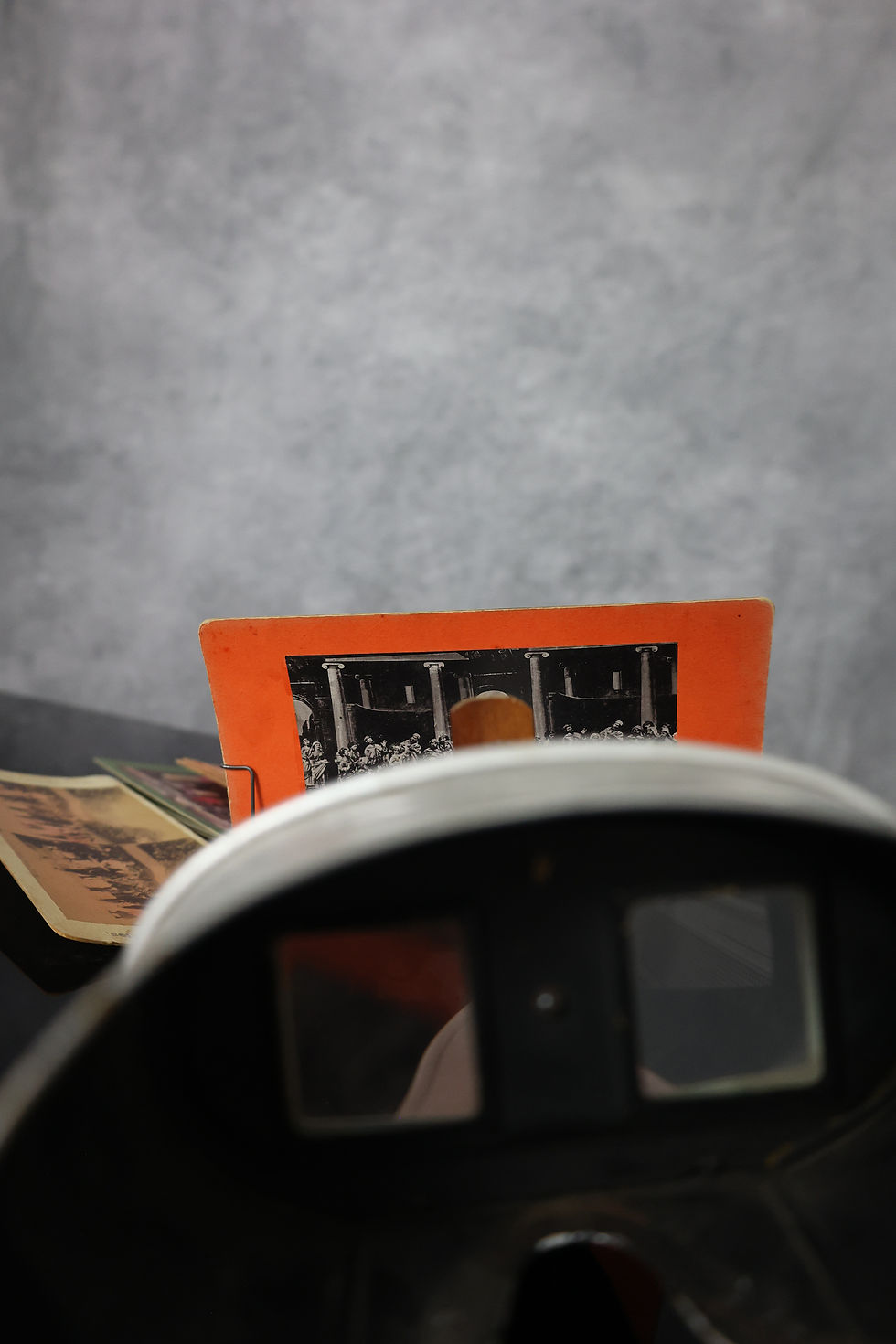
Handheld Stereoscope with Viewing Cards
England or United States, c. 1870–1900
Wood, metal, glass lenses, photographic cards
Dating & Attribution
This handheld stereoscope is attributed to the late Victorian period (c. 18
70–1900) based on its construction, materials, and intended mode of use. The combination of a turned wooden handle, sliding wooden card holder, metal support arm, and hooded viewer corresponds closely with mass-produced stereoscopes that became widely available in domestic settings during the final decades of the nineteenth century. Earlier stereoscopes of the 1840s–1850s were often bulkier table models, while later twentieth-century viewers shifted toward lighter materials and simplified forms.
The presence of photographic stereograph cards—mounted on stiff board and designed for binocular viewing—further supports a Victorian date. This format aligns with the peak of stereoscopic popularity, when advances in photography and printing made three-dimensional images accessible to middle-class households. The object’s wear patterns, including smoothing of wooden edges and gentle abrasion along the card track, indicate repeated use consistent with domestic entertainment rather than institutional display.
Together, the stereoscope’s materials, design, and associated imagery firmly situate it within the late nineteenth-century period when stereoscopic viewing functioned as both popular amusement and informal education.
The Stereoscope and the Victorian Imagination
To Victorian viewers, the stereoscope offered something extraordinary: the illusion of depth. When a card was placed into the viewer and aligned with the lenses, two flat photographs merged into a single three-dimensional scene. The result was immersive, intimate, and deeply modern. At a time when travel was limited for many and visual media was otherwise static, the stereoscope provided access to distant places, historical events, architecture, and everyday life rendered with startling realism.

Introduced earlier in the century but reaching its height of popularity after the 1860s, the stereoscope became a fixture of Victorian parlors and sitting rooms. Families gathered around it much as later generations would around radios or televisions. Unlike public spectacles such as panoramas or exhibitions, stereoscopic viewing was private and controlled. The viewer held the device close to the face, temporarily shutting out the surrounding world in favor of another scene entirely (Daily JSTOR).
This intimacy was central to its appeal. The stereoscope did not simply show an image; it transported the viewer. Victorians often described the experience as stepping into another place, a sensation heightened by the realism of photographic detail. Mountains appeared to recede into the distance. City streets seemed to stretch outward. Interiors gained volume and depth.
Victorian “Virtual Reality”
Modern scholars have often described the stereoscope as a form of Victorian virtual reality. While lacking motion or sound, it created a convincing illusion of presence that reshaped how people understood photography and perception. Stereoscopic images were marketed as educational tools, allowing viewers to “visit” foreign lands, famous landmarks, museums, and even war zones without leaving home (Bay Historical Society).
This framing aligned with Victorian values of self-improvement and moral instruction. A stereoscope was not merely a toy. It was a device through which geography, history, and culture could be absorbed visually. Publishers produced extensive stereograph series depicting classical ruins, religious sites, industrial achievements, and scenes of everyday life across the globe. Owning such images signaled curiosity, literacy, and engagement with the wider world.
At the same time, stereoscopic viewing reinforced Victorian ideas about observation and order. The experience was guided and curated. Images were selected, labeled, and sequenced. Viewers encountered the world through a specific lens. Often shaped by imperial, religious, or moral narratives embedded in the captions and subjects chosen.

Design, Materials, and Domestic Use
The design of this stereoscope reflects its domestic role. The wooden handle allowed for comfortable handheld use, while the sliding card holder enabled easy adjustment to achieve the correct focal distance. The hooded viewer reduced external light, intensifying the illusion of depth and encouraging focused attention. Metal components provided structural stability without excessive weight.
Unlike earlier scientific optical instruments, Victorian stereoscopes were designed to be approachable. They required no technical knowledge, only curiosity. Children and adults alike could use them, making stereoscopy a shared household activity. This accessibility contributed significantly to their widespread adoption.
The stereograph cards themselves were integral to the experience. Mounted photographs were durable enough for repeated handling, yet vulnerable to wear, bending, and fading. Surviving cards often show creases, softened corners, and surface abrasion; evidence of frequent use. Their physical fragility contrasts with the powerful sense of realism they once conveyed.
Education, Leisure, and Class
As with many Victorian domestic objects, the stereoscope reflects class distinctions. While stereoscopes became increasingly affordable by the late nineteenth century, they were most commonly found in middle- and upper-class homes. Working-class families had fewer opportunities for leisure and less access to such devices.
Nevertheless, the stereoscope played a role in democratizing visual knowledge. It brought images of the wider world into private homes at a scale previously unimaginable. For many viewers, it offered their first visual encounter with foreign landscapes, monumental architecture, or distant cultures.
This blending of education and leisure was characteristic of Victorian domestic life. Entertainment was expected to be edifying. The stereoscope fulfilled this expectation elegantly, combining pleasure with instruction in a single object.
Perception, the Body, and Disability
The stereoscope also intersects with Victorian understandings of vision and the body. Its operation relied on binocular vision. The brain’s ability to merge two slightly different images into one. This requirement meant that not all viewers experienced stereoscopy in the same way. Individuals with impaired vision or differences in depth perception may have found the illusion incomplete or inaccessible.
At the same time, the stereoscope contributed to growing scientific and cultural interest in perception itself. The nineteenth century saw increased study of optics, physiology, and sensory experience. Devices like the stereoscope blurred the boundaries between science and entertainment, demonstrating how technology could manipulate perception (The Preservation Lab).
In this sense, the stereoscope highlights both the possibilities and limitations of Victorian inclusivity. It expanded visual experience for many while quietly excluding others, reflecting broader patterns in nineteenth-century society.
Wear, Survival, and Meaning Today
The survival of this stereoscope, along with its cards, offers valuable insight into everyday Victorian life. Objects of leisure were often used until they wore out and then discarded. That this example remains intact suggests it was valued, stored, and perhaps passed down rather than disposed of.
Today, the stereoscope stands as a reminder that immersive media did not begin with the digital age. Victorians, too, sought escape, exploration, and wonder through technology. Their “virtual realities” were mechanical rather than electronic, yet no less powerful in shaping imagination and understanding.
Conclusion
This late Victorian stereoscope represents a pivotal moment in the history of visual culture. It transformed photography from a flat record into an immersive experience, collapsing distance and bringing the wider world into the domestic interior. At once educational tool, entertainment device, and optical experiment, the stereoscope embodies Victorian ideals of curiosity, improvement, and controlled exploration.
Placed within an archive, it functions as more than a viewing instrument. It is material evidence of how technology reshaped perception, leisure, and knowledge in the nineteenth century; inviting us to reconsider the long history of immersive media and the human desire to see beyond the immediate world.
Sources
In the Stereoscope, Another World, Daily JSTOR, https://daily.jstor.org/in-the-stereoscope-another-world/
Victorian Virtual Reality, Bay Historical Society, https://www.bayhistorical.com/victorian-virtual-reality/
The Stereoscope, The Preservation Lab, December 2013, https://blog.thepreservationlab.org/2013/12/the-stereoscope


Comments