
Brass Jardinière / Cachepot
Status: Available for Loan Consideration for exhibition, institutional study, research, or approved placement.
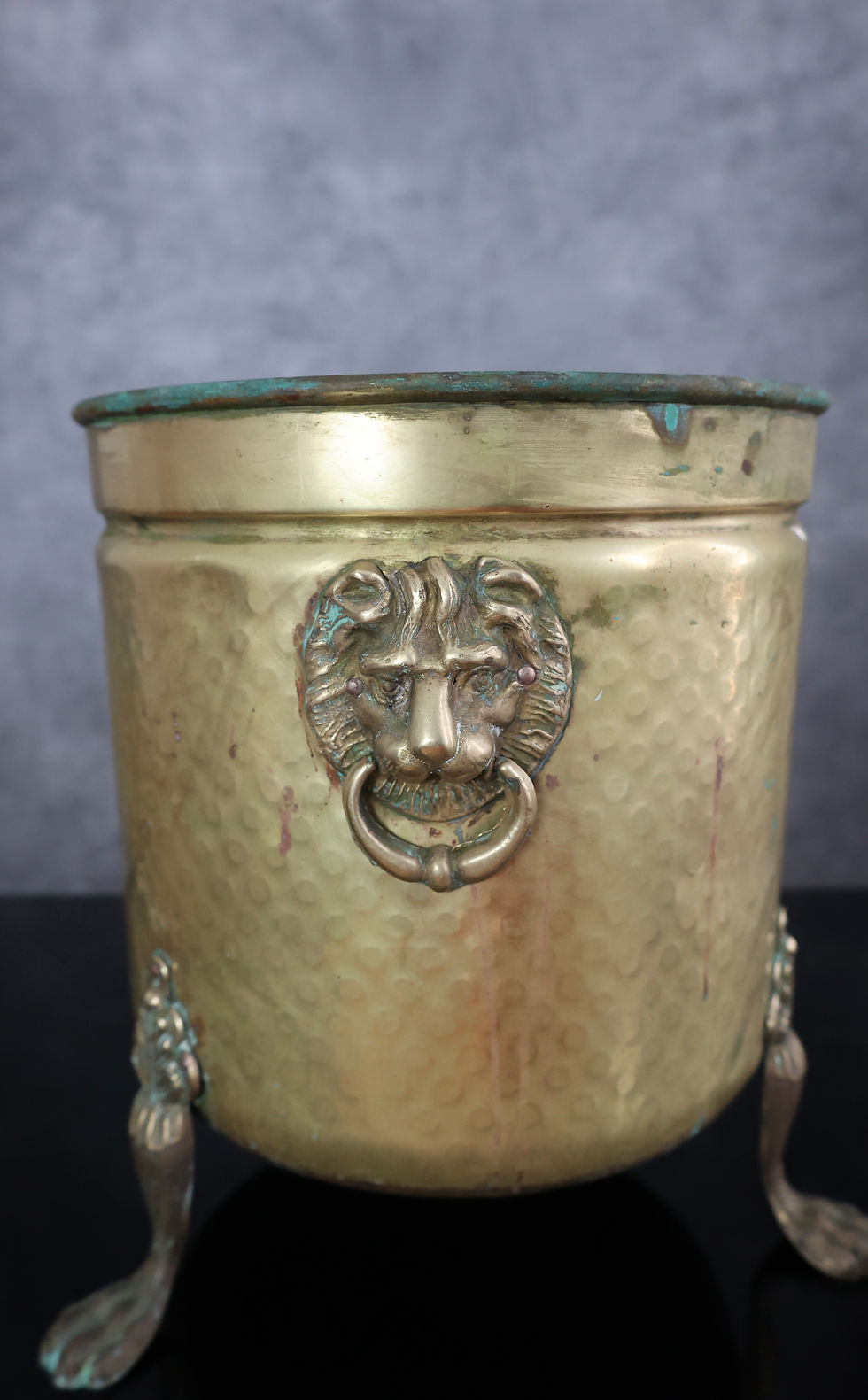
Brass Jardinière / Cachepot with Lion Mask Handles
England or Continental Europe, c. 1870–1895
Hammered brass, applied cast lion masks, paw feet
Dating & Attribution
This object is identified as a brass jardinière (also known as a cachepot) and is attributed to the late Victorian period (c. 1870–1895). The dating is supported by its material, decorative vocabulary, construction techniques, and stylistic alignment with late nineteenth-century interior metalwork.
The hammered brass body, combined with applied cast lion-head ring handles and zoomorphic paw feet, is strongly characteristic of Victorian decorative arts, particularly during the High to Late Victorian period when historicist and revival styles dominated interior design. Lion masks, in particular, were a favored Victorian motif, symbolizing strength, guardianship, and classical authority. Frequently appearing on fireplaces, furniture mounts, urns, and metal vessels.
The visible vertical seam, rolled rim, and hand-hammered surface indicate nineteenth-century fabrication rather than twentieth-century casting or spinning. Earlier Georgian or Regency examples tend to be more restrained and symmetrical, while Edwardian and later pieces move toward lighter forms and reduced ornament. This object’s weight, density, and assertive decoration firmly situate it within the Victorian era.
The Jardinière in the Victorian Interior
The jardinière rose to prominence in the Victorian period alongside a growing cultural fascination with plants, botany, and interior ornamentation. As middle-class homes
expanded in size and decorative ambition, plants became integral to domestic display. These were symbols of cultivation, leisure, and moral refinement.
Rather than placing plants directly into decorative containers, Victorians often used cachepots to conceal utilitarian flower pots. Jardinières such as this one were designed to sit prominently in parlors, conservatories, and entrance halls, functioning as both plant holders and sculptural furnishings.
This object reflects that dual purpose. Its substantial brass construction and elaborate detailing suggest it was meant to be seen, not hidden. An anchor within the visual hierarchy of the room.
Design, Materials, and Craftsmanship

The hammered brass surface is a key diagnostic feature. Hammering created subtle texture that caught and reflected light, lending warmth and depth to interior spaces illuminated by gas or candlelight. Brass was prized for its durability, polish, and association with luxury, yet it remained more accessible than silver or bronze.
The lion-head ring handles are applied cast elements, likely produced separately and affixed to the body. Their expressive modeling (deep-set eyes, stylized mane, and heavy ring) reflects Victorian taste for bold, legible ornament. The ring held in the lion’s mouth references classical door knockers and ancient urns, reinforcing the object’s historicist lineage.
The paw feet elevate the vessel slightly off the surface, both protecting furniture and enhancing its sculptural presence. Zoomorphic feet were a common Victorian device, borrowing from Renaissance, classical, and medieval precedents to lend objects a sense of gravitas and permanence.
Victorian Eclecticism and Revival Style
Victorian design is often defined by eclectic historicism; the deliberate blending of motifs drawn from classical antiquity, the Renaissance, Gothic traditions, and non-Western sources. This jardinière exemplifies that approach.
The lion masks evoke classical and Renaissance models, while the hammered brass body reflects broader nineteenth-century interest in handcraft, material honesty, and surface richness. Such objects were often marketed as both decorative and “artistic,” aligning with Victorian ideals of cultured domesticity.
Rather than adhering to a single historical style, the object synthesizes multiple references into a unified, assertive form. Which was an approach typical of late Victorian decorative metalwork.
Function, Display, and Social Meaning
Beyond its practical role, the jardinière functioned as a marker of taste. Displaying plants indoors required space, light, and time. Resources associated with comfort and respectability. The container itself further signaled refinement, suggesting familiarity with current decorative trends.
Placed on the floor, a pedestal, or a low table, this jardinière would have contributed to the layered interiors Victorian households favored. Where rooms filled with texture, ornament, and symbolic objects thrived. It participated in the creation of an environment meant to reflect moral order, prosperity, and cultivated sensibility.

Wear, Patina, and Survival
The visible patina (oxidation, surface discoloration, and softening of detail) indicates age and prolonged use rather than modern distressing. Such wear is consistent with brass objects that were periodically polished yet inevitably exposed to moisture from plants and soil.
That the jardinière survives intact, with its applied elements preserved, suggests it was valued and retained even as tastes changed. Many such objects were discarded or melted down for scrap metal in later periods. Its survival enhances its historical significance.
Transition and Legacy
By the early twentieth century, interior design trends shifted toward lighter materials and simplified forms. Heavy brass jardinières fell out of favor, replaced by ceramic planters, stands, and later modernist designs. As a result, objects like this became increasingly associated with an earlier, more ornate domestic ideal.
Today, the jardinière stands as a material record of Victorian interior life; where decoration, symbolism, and function were inseparable.
Conclusion
This brass jardinière is a confidently Victorian object, dating to the late nineteenth century and embodying the era’s taste for ornament, historic reference, and material richness. Through its lion masks, paw feet, and hammered surface, it transforms a utilitarian vessel into a sculptural presence.
Within an archive, it speaks not only to plant culture but to Victorian values more broadly: the desire to civilize nature, to display refinement, and to surround daily life with objects that conveyed meaning and permanence. It is a vessel not just for plants, but for the decorative ambitions of its age.
Sources
Encyclopaedia Britannica, “Jardinière”https://www.britannica.com/art/jardiniere
Victoria and Albert Museum (V&A), Collections & Research: Victorian Decorative Arts and Metalworkhttps://www.vam.ac.uk/collections
Metropolitan Museum of Art, Heilbrunn Timeline of Art History – 19th-Century Decorative Artshttps://www.metmuseum.org/toah/
Thornton, Peter. Authentic Décor: The Domestic Interior 1620–1920London: Weidenfeld & Nicolson, 1984.
Wainwright, Clive. The Romantic Interior: The British Collector at Home, 1750–1850Yale University Press / V&A Publications.
Cooper, Jeremy. Victorian and Edwardian Furniture and InteriorsThames & Hudson.


Comments