
Chicago Pencil Sharpener
Status: Available for Loan Consideration for exhibition, institutional study, research, or approved placement.
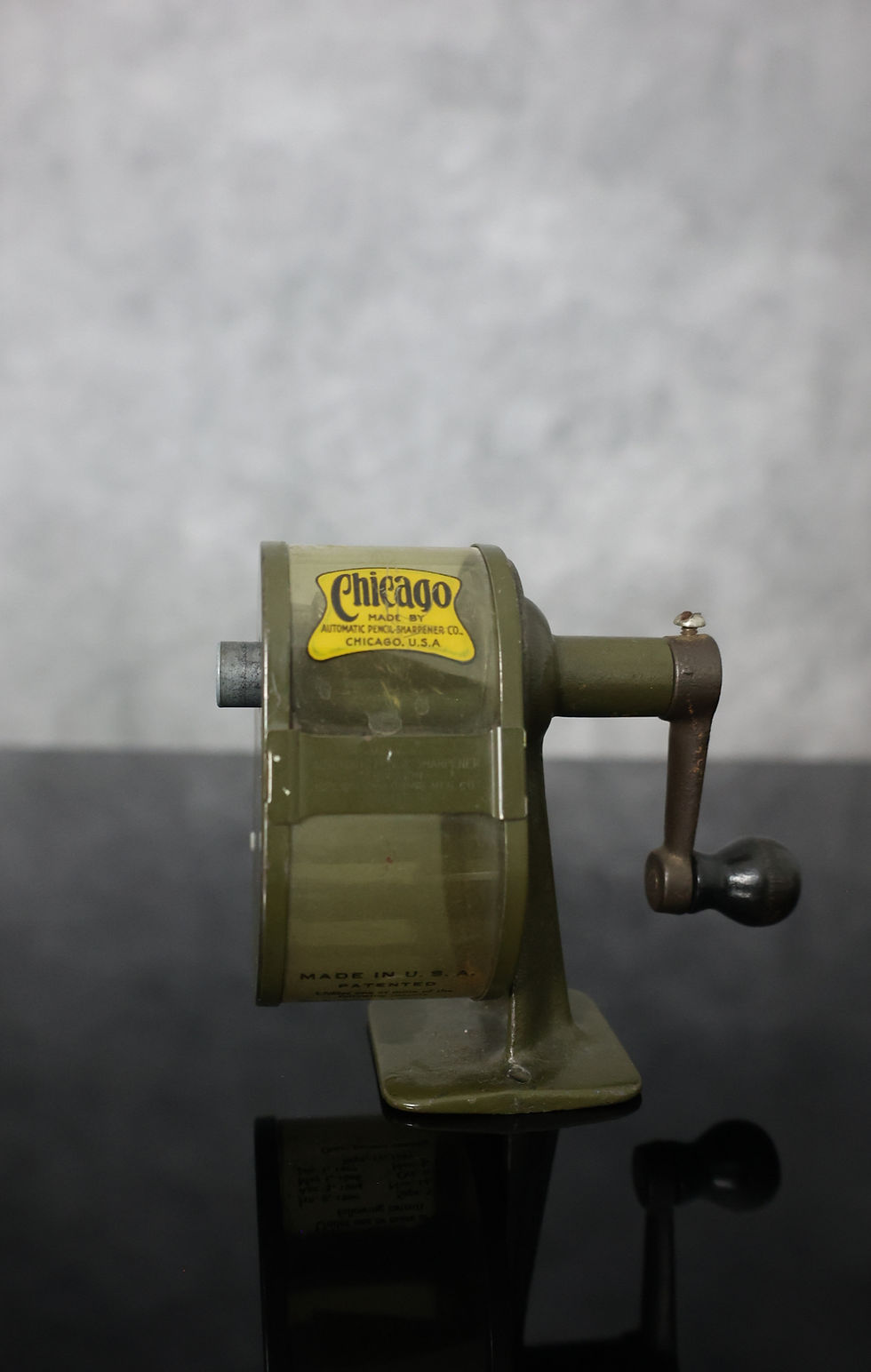
Chicago Automatic Pencil Sharpener
(Automatic Pencil Sharpener Company)
United States (Chicago, Illinois),
c. 1910–1935
Cast metal body with enamel finish, steel internal gearing, hand-crank mechanism
Dating & Attribution
This object is identified as a hand-cranked Chicago Automatic Pencil Sharpener, produced by the Automatic Pencil Sharpener Company (APSCO) of Chicago, Illinois. Based on label design, construction, and known manufacturing history, this example dates to the early twentieth century, most plausibly between circa 1910 and 1935.
The paper label reading “Chicago – Made by Automatic Pencil Sharpener Co., Chicago, U.S.A.” corresponds with APSCO branding used during its early national expansion, prior to mid-century corporate redesigns. The cast metal housing, substantial weight, and hand-crank mechanism place it before the widespread adoption of electric sharpeners, which began appearing in offices and schools in the late 1930s and 1940s.
Earlier pencil sharpeners of the nineteenth century were typically pocket-sized or knife-based. This wall or desk mounted mechanical sharpener reflects a shift toward institutional efficiency, designed for repeated daily use in schools, offices, drafting rooms, and factories.
Writing, Standardization, and Modern Work
The rise of mechanical pencil sharpeners parallels the standardization of written work in industrial America.
This sharpener represents a moment when writing tools became part of a system: standardized pencils, standardized paper, standardized desks, and standardized accessories. The ability to quickly and uniformly sharpen pencils was essential in environments where accuracy, speed, and legibility mattered.
Design, Materials, and Function

The defining feature of this sharpener is its hand-crank mechanism, which drives an internal cylindrical cutter fitted with multiple steel blades. Turning the crank rotates the cutter around the pencil, shaving wood evenly while preserving the graphite core. This design produced a consistent point and reduced breakage, a significant improvement over knives or simpler sharpeners.
The heavy cast metal body provided stability during use, preventing slippage and absorbing vibration. The olive-green enamel finish is typical of early twentieth-century industrial and educational equipment, favoring durability and subdued color over ornament.
The crank handle, shaped for grip, reflects ergonomic considerations emerging during this period, when manufacturers began paying closer attention to repetitive motion and user comfort in workplace tools.
Schools, Offices, and Discipline
Mechanical pencil sharpeners were fixtures of classrooms and offices, often mounted at a shared location. Their placement reinforced order and routine: sharpening pencils became a brief, regulated interruption within structured environments.
In schools, sharpeners like this one were tied to discipline and efficiency. Students queued, turned the crank, and returned to their desks. An everyday ritual that reinforced collective rhythm and institutional control. In offices, the sharpener supported clerical accuracy and productivity, essential in an era increasingly governed by paperwork.
Transitional Technology
This object belongs to a broader category of transitional office technology, positioned between hand tools and electrified devices. Like hand-powered vacuum sweepers or mechanical scales, it reflects a period when human energy was still central to operation, but increasingly mediated through machines.
Electric pencil sharpeners would later automate this task entirely, but hand-cranked models remained in use well into the mid-twentieth century, particularly in schools and smaller offices. Their longevity speaks to the effectiveness and reliability of the design.
Wear, Survival, and Evidence of Use
Surface wear on the enamel, smoothing of the crank handle, and minor abrasions along the housing indicate prolonged use. These marks are consistent with an object handled daily by many users over years or decades.
Unlike decorative objects, pencil sharpeners were purely utilitarian. Their survival suggests durability and institutional value rather than sentimentality. This example remains structurally intact, preserving both its mechanical function and its material testimony.
Conclusion
This Chicago Automatic Pencil Sharpener embodies the infrastructure of everyday intellectual labor. Quiet, durable, and efficient, it supported the routines of writing, learning, and record keeping that defined early twentieth-century work.
As an archival object, it documents how modern systems of education and administration relied not only on ideas and institutions, but on well designed tools that shaped daily behavior. It stands as a material witness to the disciplined, mechanized rhythms of early modern work.
Sources
Made in Chicago Museum, Automatic Pencil Sharpener Companyhttps://www.madeinchicagomuseum.com/single-post/automatic-pencil-sharpener-co/
Office Museum, History of Pencil Sharpenershttps://www.officemuseum.com/pencil_sharpeners.htm
Smithsonian National Museum of American History, Writing Technologies and Office Toolshttps://americanhistory.si.edu
Hagley Museum and Library, Industrial Office Equipment and Business Technologyhttps://www.hagley.org


Comments