
Devilbiss Atomizer
- Mar 20
- 4 min read
Status: Available for Loan Consideration for exhibition, institutional study, research on early twentieth-century medical devices, or approved placement.
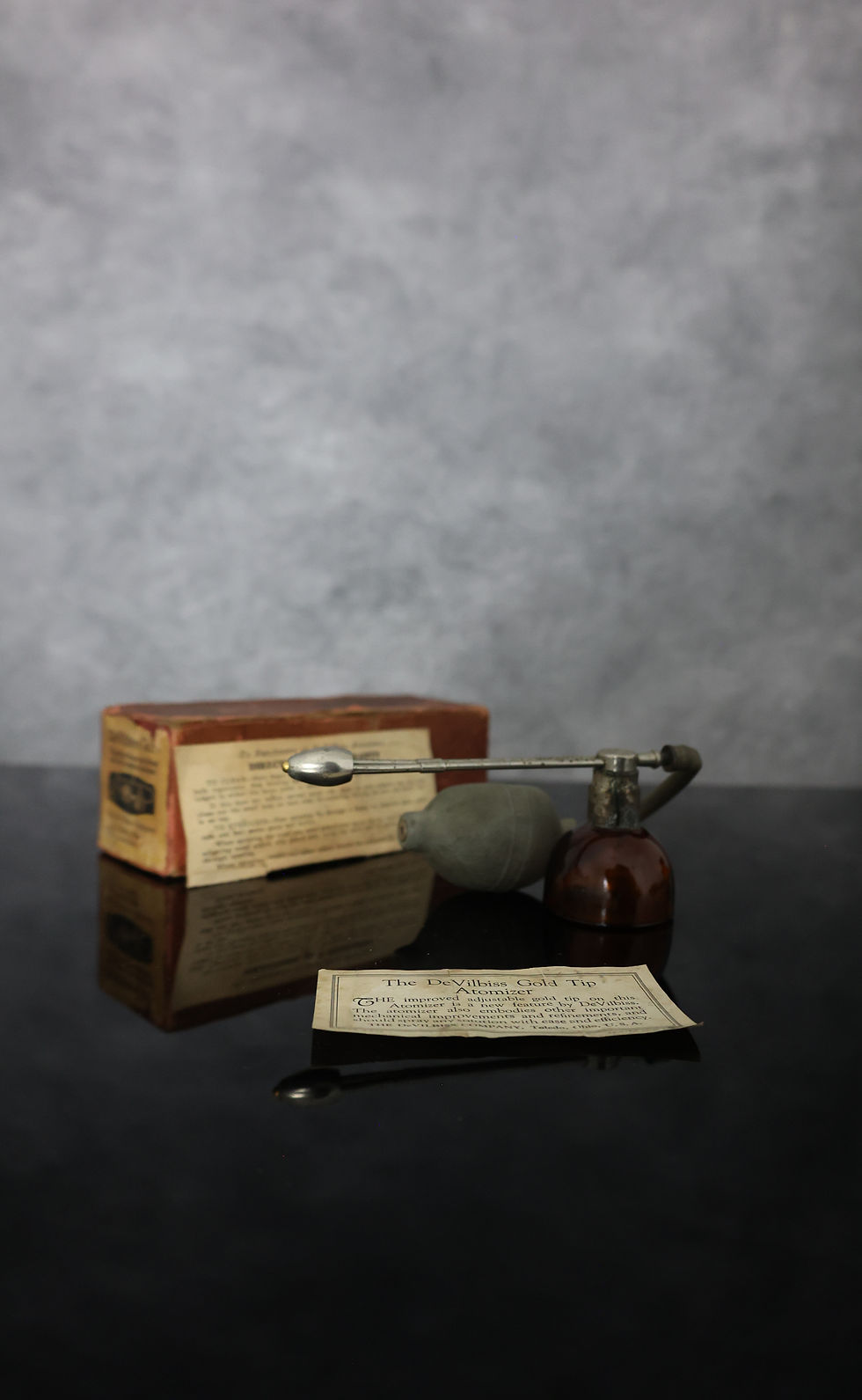
DeVilbiss Medical Atomizer Set
United States,
1905–1925
Glass reservoir, rubber bulb, metal spray nozzle, printed cardboard packaging, instructional ephemera
Dating & Attribution
This object is identified as a DeVilbiss medical atomizer set, commonly referred to as “The DeVilbiss Outfit,” produced in the United States during the early twentieth century, approximately between 1905 and 1925. The set includes a glass medicine reservoir, a rubber compression bulb, a metal atomizing nozzle, original packaging, and printed instructions.
The DeVilbiss Company, founded by Dr. Allen DeVilbiss in the late nineteenth century, became one of the leading manufacturers of atomizers used for administering liquid medications in fine spray form. These devices were widely used for the treatment of nasal, throat, and respiratory conditions before the development of modern aerosol inhalers and pharmaceutical delivery systems.
The form, materials, and packaging of this example correspond closely with early DeVilbiss atomizers documented in museum and medical collections, particularly those produced in the first decades of the twentieth century when such devices were commonly prescribed for home use.
Construction and Device Design
The atomizer consists of a small glass bottle reservoir designed to hold liquid medication, attached to a rubber bulb that functions as a manual air pump. When the bulb is compressed, air is forced through the device, drawing liquid upward through an internal tube and dispersing it through

the metal nozzle as a fine mist.
The nozzle is elongated and slightly angled, allowing the user to direct the spray into the nasal passages or throat. This design reflects the intended medical use of the device, which was to deliver medication directly to affected areas of the respiratory system.
The rubber bulb is a critical functional component, providing the pressure necessary to atomize the liquid. Early twentieth-century atomizers relied entirely on manual compression rather than pressurized propellants, making them simple but effective tools for home medical treatment.
The set retains its original cardboard packaging, which includes printed instructions and product information. Packaging of this type was typical of early consumer medical devices and often emphasized both ease of use and therapeutic effectiveness. The presence of original instructions further confirms that the device was marketed for self-administration within the home, rather than exclusively for clinical use.
Medical and Historical Context
Atomizers such as this were widely used during the late nineteenth and early twentieth centuries to treat a variety of conditions, including colds, sinus infections, throat irritation, and respiratory illnesses. Physicians commonly prescribed liquid medications that patients could administer using atomizers, allowing for targeted treatment of specific areas.
The development of atomizers reflects a broader shift in medical practice during this period, as treatment moved increasingly toward mechanical and device-assisted methods. Rather than relying solely on oral medications or topical applications, atomizers allowed for the controlled delivery of medicine in vaporized form.
The DeVilbiss atomizer in particular became one of the most recognized designs in American medical history. Its success was due in part to its simplicity, durability, and effectiveness, as well as the company’s ability to market the device directly to both physicians and consumers.
These devices were especially important before the widespread use of antibiotics and modern inhalers. They represent an intermediate stage in the evolution of respiratory treatment, bridging earlier home remedies and later pharmaceutical technologies.
Domestic Medical Use

One of the defining characteristics of this object is its role within the domestic medical environment. Unlike many earlier medical tools that were confined to professional settings, atomizers were designed to be used by patients at home.
Instruction sheets included with the device provided guidance on how to prepare and administer treatments, reflecting a growing emphasis on patient participation in healthcare. Families often kept such devices as part of a home medical kit, using them repeatedly for various ailments.
The presence of original packaging and instructions suggests that this set was part of a broader consumer market in which medical devices were increasingly standardized, branded, and distributed through pharmacies and mail-order catalogs.
Technological Significance
The DeVilbiss atomizer represents an early form of mechanized drug delivery, a concept that would later evolve into modern inhalers, nebulizers, and aerosol systems. By converting liquid medication into a fine mist, the device increased the surface area of the medicine, allowing it to be more effectively absorbed by the body.
This principle remains central to respiratory medicine today, making the atomizer an important precursor to contemporary medical technologies.
The use of glass, rubber, and metal components reflects the materials commonly available at the time and highlights the transition from handcrafted medical tools to more standardized manufactured devices.
Condition and Material Evidence

The object retains its original glass reservoir, rubber bulb, and metal nozzle, along with the accompanying packaging and printed instructions. The materials show signs of age consistent with early twentieth-century manufacture, including patina on the metal components and wear to the cardboard packaging.
The survival of the complete set, including ephemera, significantly enhances its historical value, as such items were often discarded after use.
Provenance
This DeVilbiss atomizer set was acquired through a private sale, with no additional ownership history currently known.
Conclusion
The DeVilbiss medical atomizer set represents a significant example of early twentieth-century medical technology designed for both professional and domestic use. Combining simple mechanical design with practical medical application, the device reflects a period when healthcare was becoming increasingly accessible within the home.
As a precursor to modern respiratory treatment devices, the atomizer illustrates the evolving relationship between medicine, technology, and everyday life. Preserved with its original packaging and instructional materials, the set offers valuable insight into how patients engaged with medical treatment in the early twentieth century and how manufacturers like DeVilbiss helped shape the development of modern healthcare practices.
Sources
Wood Library-Museum of Anesthesiology. DeVilbiss Atomizers Collectionhttps://www.woodlibrarymuseum.org/museum/devilbiss-atomizers/
Smithsonian National Museum of American History. DeVilbiss Atomizer (Object No. NMAH_721925)https://americanhistory.si.edu/collections/object/nmah_721925
Medline Industries. DeVilbiss Atomizers Product History and Designhttps://www.medline.com/product/DeVilbiss-Atomizers/Z05-PF185206
General reference works on early twentieth-century medical devices and respiratory treatment methods.


Comments