
Pince-Nez Eyeglasses with Beaded Case
- Mar 9
- 4 min read
Status: Available for Loan Consideration for exhibition, institutional study, research on optical history, or approved placement.

Pince-Nez Eyeglasses with Beaded Case
United States or Europe,
c. 1880–1915
Gold-tone metal pince-nez frame with glass lenses, attached retaining chain, decorative beaded spectacle case
Dating & Attribution
This object is identified as a pair of pince-nez eyeglasses, a style of vision-correcting spectacles that rests on the bridge of the nose without temple arms. Based on construction, materials, and historical context, this example dates approximately to circa 1880–1915, during the late nineteenth and early twentieth centuries when pince-nez designs were widely used.
The frame consists of a spring bridge mechanism designed to grip the nose gently, allowing the glasses to remain in place without arms extending over the ears. This design was one of the most recognizable optical forms of the period and was particularly associated with professionals, academics, and fashionable urban wearers.
The presence of a retaining chain reflects common practice for pince-nez spectacles. Because the glasses did not attach to the ears, wearers frequently used chains or cords connected to clothing to prevent loss when the spectacles were removed.
The absence of a manufacturer’s mark is not unusual. Many pince-nez frames were produced by optical manufacturers and then sold through local opticians who installed custom lenses. As a result, surviving examples often lack identifiable branding.
Design, Materials, and Function
The glasses feature oval glass lenses mounted in thin metal rims, joined by a spring bridge that applies light pressure to the nose. This mechanism allowed the spectacles to be quickly placed or removed without adjusting temples.

The thin metal frame provided durability while maintaining a lightweight profile suitable for extended wear. The lenses were individually ground by opticians according to the wearer’s prescription, reflecting the personalized nature of early optical care.
The attached fine-link chain would typically be secured to a lapel, waistcoat, or dress, ensuring that the spectacles remained accessible while reducing the risk of damage or loss.
The Rise and Decline of Pince-Nez
Pince-nez spectacles became fashionable in the late nineteenth century, coinciding with increasing literacy, bureaucratic work, and professional occupations that required sustained reading and writing. The design allowed for compact portability and was often perceived as elegant or intellectual in appearance.
By the early twentieth century, pince-nez glasses were widely worn across Europe and North America. They appeared frequently in photographs, advertisements, and portraits of professionals such as lawyers, teachers, physicians, and scholars.
However, by the 1920s and 1930s, the popularity of pince-nez began to decline. Improvements in frame design made temple-style eyeglasses more comfortable and secure. Glasses with arms that extended over the ears gradually replaced nose-pinching styles, which could slip during movement or prolonged wear.
As a result, pince-nez spectacles came to be associated with earlier fashion and eventually disappeared from everyday use, surviving primarily in historical imagery and costume contexts.
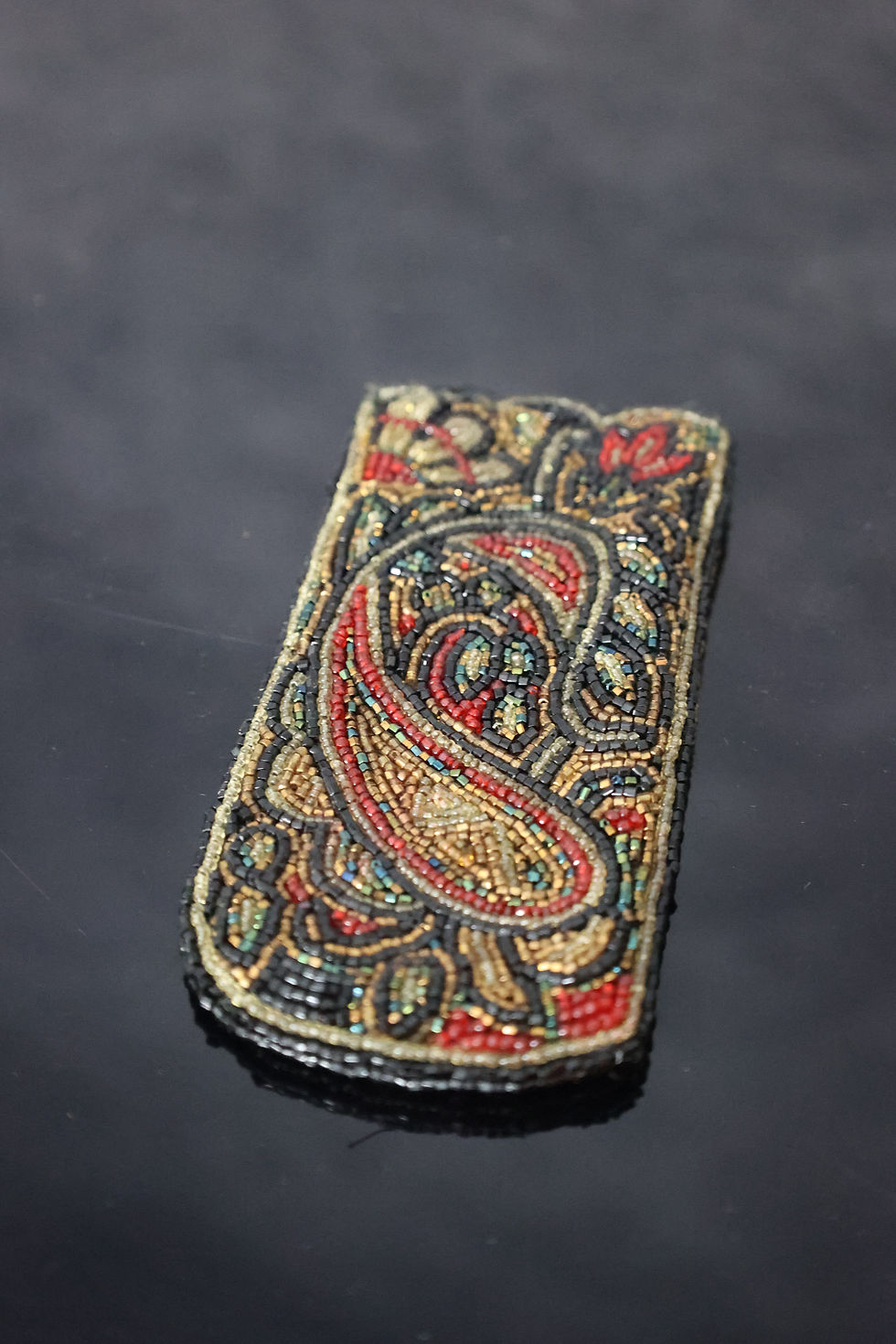
The Beaded Spectacle Case
The accompanying beaded spectacle case adds significant cultural context to the object. Cases of this type were commonly produced during the late nineteenth and early twentieth centuries, often handmade using glass seed beads sewn onto fabric.
Beaded cases served both protective and decorative purposes. The rigid or semi-rigid structure shielded fragile lenses, while the elaborate beadwork reflected personal taste and craftsmanship. Many such cases were made by women as domestic handicrafts or purchased as fashionable accessories.
The intricate paisley-style bead pattern visible on this case reflects decorative trends popular in the Victorian and Edwardian periods, when ornamental textile arts were widely practiced. Cases like this often accompanied pince-nez spectacles because their compact form fit neatly inside narrow pouches or clamshell-style cases.
Vision Correction and Everyday Life
During the nineteenth and early twentieth centuries, eyeglasses became increasingly important as literacy expanded and written communication became central to professional life. Reading newspapers, writing correspondence, and maintaining business records required clear vision, making spectacles essential tools for many individuals.
Pince-nez glasses offered a practical solution for people who needed occasional correction but preferred not to wear full-frame spectacles continuously. Their portability allowed them to be easily stored and quickly deployed when needed.
This pair represents a transitional moment in optical history, when spectacle design balanced practicality, fashion, and emerging standards in vision care.
Wear, Survival, and Evidence of Use
The lenses remain intact, with minor surface marks consistent with age and handling. The metal frame shows light wear but retains its structural integrity, indicating careful use and storage.
The survival of the beaded case significantly enhances the interpretive value of the object. Spectacle cases were frequently lost or replaced, and their preservation offers insight into how eyewear was protected and carried.
Together, the glasses and case form a cohesive set that illustrates both the functional and decorative aspects of early optical accessories.

Transitional Optical Technology
Pince-nez spectacles represent a transitional stage in eyewear design. They bridge the gap between earlier hand-held or nose-balanced spectacles and the modern temple-style glasses that became standard by the mid-twentieth century.
While eventually replaced by more stable designs, pince-nez glasses played a significant role in the development of modern optical culture. Their popularity reflects a period when eyewear was becoming both a practical necessity and a visible marker of education and professionalism.
Conclusion
This pair of pince-nez eyeglasses, accompanied by a beaded spectacle case, represents a distinctive form of vision correction from the late nineteenth and early twentieth centuries. The design reflects a time when eyewear balanced elegance and practicality, while the decorative case highlights the intersection of personal accessories and functional technology.
Preserved today, the object documents both the technological evolution of eyeglasses and the social importance of clear vision in an increasingly literate and professionalized society.
Sources
Eyeseum Museum of Vision, Spectacle Cases Collectionhttps://www.eyeseum.us/spectacle-cases/
Trystan Craft, A Brief History of Eyeglasseshttps://www.trystancraft.com/costume/2025/07/17/a-brief-history-of-eyeglasses/
Smithsonian National Museum of American History, Optical Instruments Collectionhttps://americanhistory.si.edu
College of Optometrists (UK), History of Spectacleshttps://www.college-optometrists.org
Museum of the Eye, American Academy of Ophthalmology, History of Vision Correctionhttps://www.museumoftheeye.org


Comments