
American Red Cross Field Trunk
Status: Available for Loan Consideration for exhibition, institutional study, research on wartime and postwar relief systems, or approved placement.

American Red Cross Field Trunk
Issued to John W. Boomer, Field Director
United States,
c. 1940–1955
Painted steel trunk with stenciled identification
Dating & Attribution
This object is a mid-20th-century American Red Cross field trunk, clearly stenciled with the name John W. Boomer, identified as a Field Director within the organization. The inscription, reading “FIELD DIRECTOR AMERICAN RED CROSS,” alongside a serial number, indicates institutional issue rather than personal ownership. The construction (riveted steel panels, reinforced corners, and a durable latch system) places it within a World War II to early Cold War timeframe, approximately 1940 to 1955. The standardized stencil lettering and numbering reflect a system of organized distribution, where equipment was cataloged, assigned, and deployed across operational environments.
Construction and Material Evidence
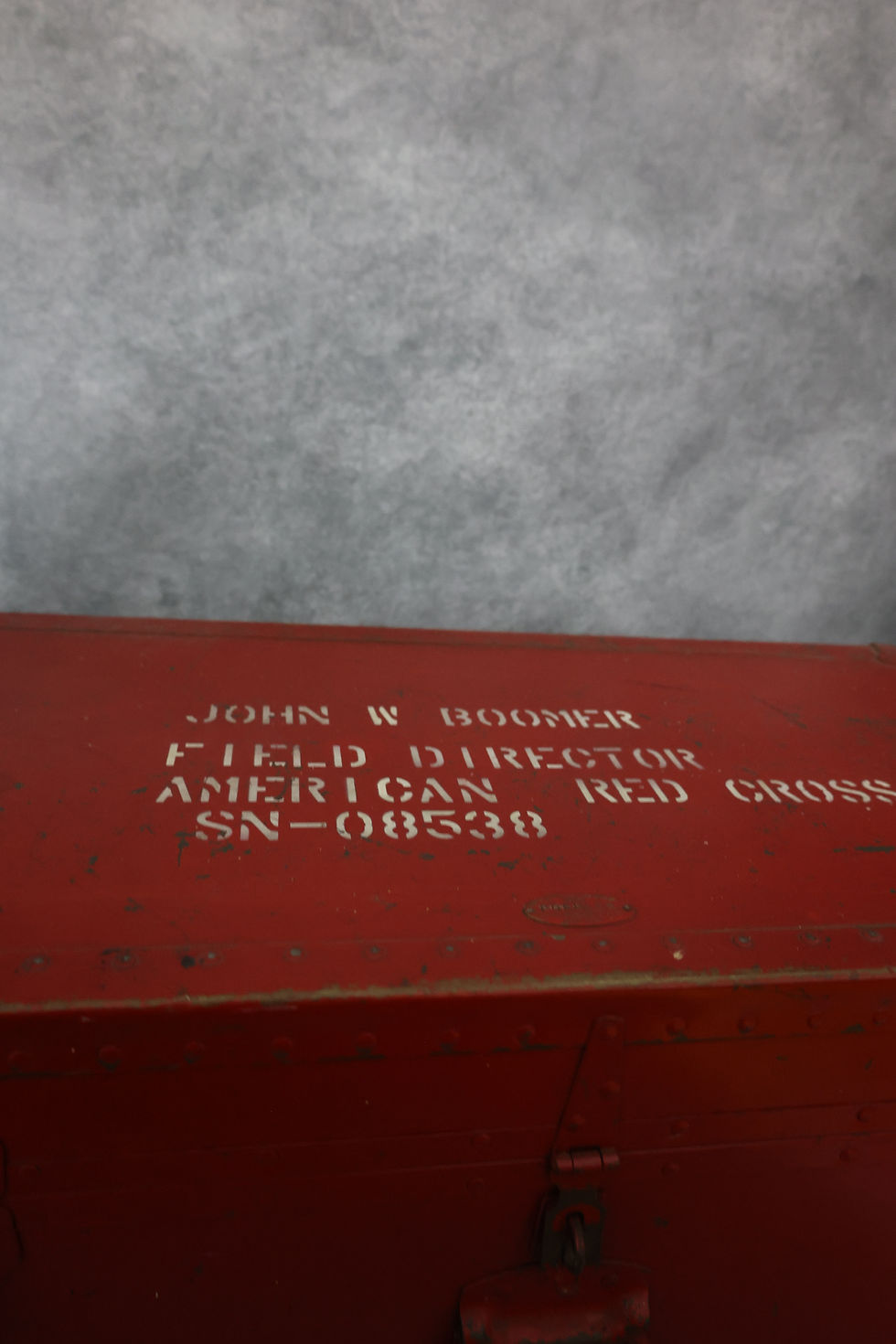
The trunk is fabricated from pressed steel and finished in a bold red paint consistent with American Red Cross visual identity. Its reinforced edges, riveted seams, and heavy-duty hardware suggest it was built for transport under demanding conditions. The presence of surface wear, chipped paint, and oxidation indicates prolonged use, rather than preservation. This was an object designed to move, to be handled frequently, and to endure environments far removed from controlled domestic or office spaces. Its physical condition supports its interpretation as an active field object rather than a ceremonial or storage piece.
Functional Interpretation
This trunk functioned as a mobile operational unit within the Red Cross system. As a Field Director, John W. Boomer would have required a centralized, transportable container for materials essential to his role. The trunk likely carried documents, reports, and correspondence related to relief coordination, alongside supplies or tools necessary for fieldwork. It may also have contained administrative materials used to track aid distribution or manage communication between military personnel, civilians, and Red Cross networks. In this sense, the trunk acted as a portable headquarters, consolidating the logistical and bureaucratic elements of humanitarian work into a single object that could move wherever it was needed.
Postwar Context and Relief Work
The trunk belongs to a period when the American Red Cross was deeply involved in both wartime support and postwar recovery. During and after World War II, the organization expanded its reach, assisting not only soldiers but also families, displaced populations, and domestic communities facing shortages and structural strain. Field directors operated at the intersection of these systems, managing aid, coordinating responses, and maintaining communication across regions. By the early Cold War period, these efforts extended into continued emergency response and public health initiatives, particularly those tied to blood donation and medical infrastructure.

Newspaper Reference and Blood Donation Efforts
A newspaper clipping associated with this archive, titled “Blood Donor Response in South State” from Lansing, provides a direct contextual link to the type of work this trunk supported. The article describes how Red Cross blood donation efforts in Michigan had been described as “remarkable,” while also emphasizing ongoing shortages in southern regions of the state. It reflects a moment when civilian participation in blood drives had become a critical extension of wartime mobilization, continuing into the postwar years and the Korean War period. These programs relied on regional coordination, public engagement, and logistical systems capable of collecting, storing, and distributing blood at scale.
The connection between the trunk and this article is not merely thematic. The geographic reference to Michigan, including the Upper Peninsula, aligns directly with the object’s acquisition history and suggests that this trunk existed within that same network of regional Red Cross activity. The article captures the public-facing side of relief efforts, while the trunk
represents the infrastructure that made such efforts possible.
Provenance

This trunk is explicitly marked to John W. Boomer, providing a direct personal and institutional attribution. It was acquired through an auction in the Upper Peninsula of Michigan, a detail that reinforces its geographic and operational context. While no additional documentation accompanies the object, the stencil itself serves as a primary identifier, linking it to an individual role within the American Red Cross system.
Conclusion
This American Red Cross field trunk represents the physical and administrative backbone of mid-20th-century humanitarian work. It is an object built not for display, but for movement, organization, and function. Through its construction, inscription, and contextual pairing with regional reporting on blood donation efforts, it reveals how large-scale aid systems operated in practice.
Sources
American Red Cross. History of the American Red Crosshttps://www.redcross.org
Library of Congress. World War II and Postwar Civilian Mobilization
The National WWII Museum. Home Front & Humanitarian Effortshttps://www.nationalww2museum.org
Newspaper clipping:“Blood Donor Response in South State,” Lansing (UP) – mid-20th century regional reporting on Red Cross blood donation programs and shortages in Michigan
General historical references on Red Cross field operations, blood donation programs, and postwar relief infrastructure in the United States.


Comments