
Chevalier Paris Opera Glasses
Status: Available for Loan Consideration for exhibition, institutional study, research on nineteenth-century optical instruments and leisure culture, or approved placement.

Chevalier Opera Glasses with Case
Attributed to the Chevalier Family of Opticians, Paris France,
c. 1850–1880
Brass optical barrels, leather-wrapped body, central focus mechanism, original fitted case
Dating & Attribution
This object is identified as a pair of Chevalier opera glasses, attributed to the renowned Chevalier family of opticians in Paris, dating approximately to circa 1850–1880. The Chevalier firm was among the most important optical manufacturers in nineteenth-century France, producing scientific instruments, lenses, and viewing devices during a period of rapid advancement in optical technology.
The construction and materials of this example featuring brass barrels, a compact binocular form, and a central focusing mechanism. Which correspond with mid- to late-nineteenth-century opera glasses designed for civilian use rather than scientific observation. Opera glasses of this type were widely produced in Paris, which was a major center for optical manufacturing and luxury goods.
The survival of the original fitted case, with its shaped interior designed to accommodate the glasses, further supports a nineteenth-century date, as such cases were standard for protecting delicate optical instruments during transport and storage.
Construction and Object Design
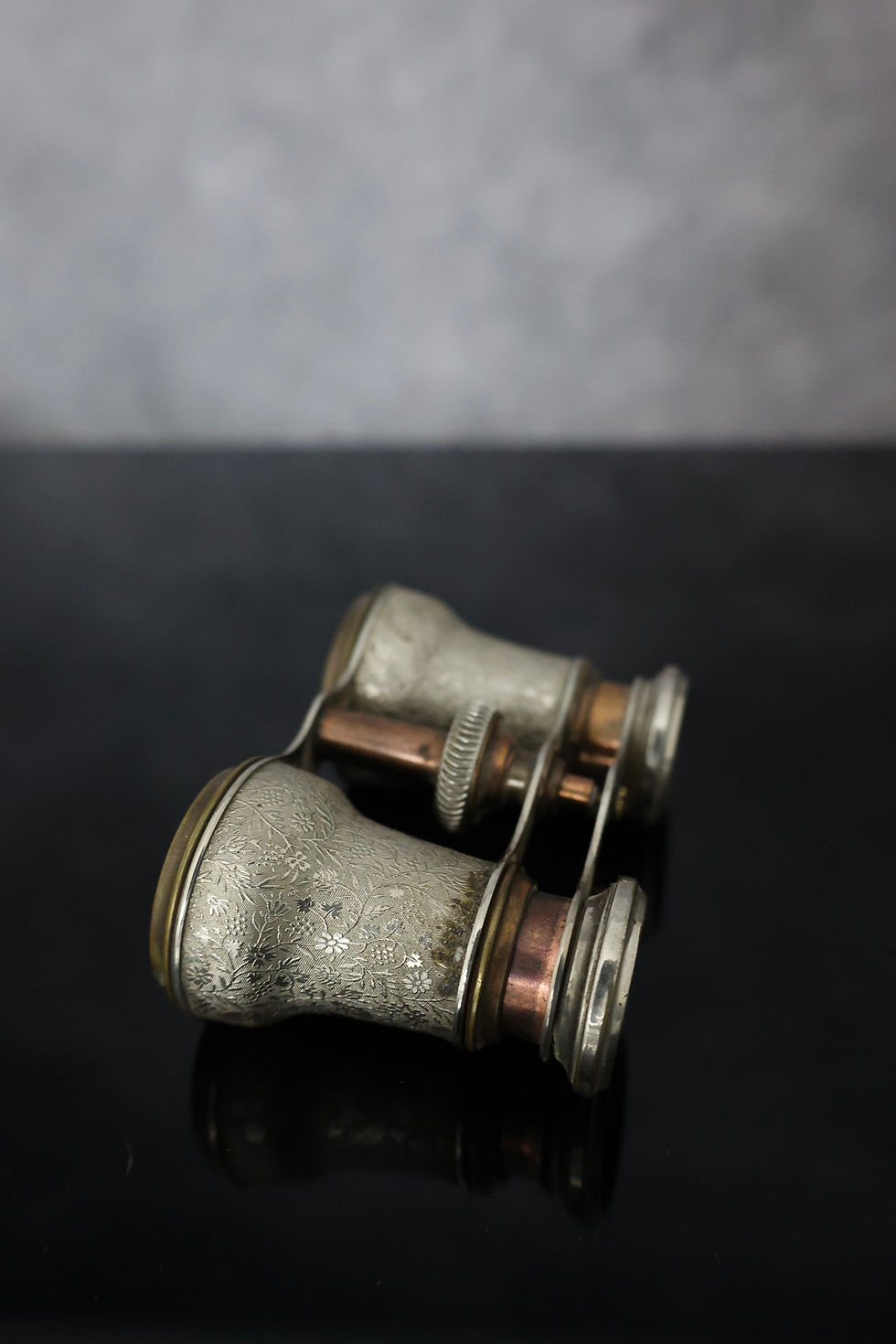
The opera glasses consist of two parallel optical tubes (barrels) constructed from brass and fitted with lenses that provide low magnification suitable for close-range viewing. The exterior of the barrels appears to be wrapped or finished in a textured material, likely leather or a similar covering, providing both grip and aesthetic refinement.
A central focusing mechanism connects the two barrels, allowing the user to adjust the distance between the lenses simultaneously. This mechanism typically operates through a small wheel or sliding adjustment, enabling the viewer to bring distant subjects into clear focus.
The compact size and lightweight construction distinguish opera glasses from larger field binoculars. They were specifically designed for indoor or controlled environments, such as theaters and opera houses, where viewers needed only modest magnification to observe performances from a distance.
The accompanying case is shaped to the contours of the glasses and constructed from a rigid material covered in leather or paper. The interior is lined to protect the instrument from scratches and movement, reflecting the importance of preserving the delicate optical components.
The Chevalier Family and Optical Innovation
The Chevalier family played a significant role in the development of nineteenth-century optical instruments. Based in Paris, they were involved in producing lenses and devices used in both scientific and recreational contexts, including early photographic equipment and viewing instruments.
Parisian opticians such as the Chevaliers were at the forefront of optical innovation during this period, contributing to advancements in lens design and manufacturing techniques. Their work supported the broader expansion of visual technologies, including microscopy, photography, and personal viewing devices.
Opera glasses represent a more accessible application of these advancements, translating precision optical knowledge into objects intended for everyday leisure and cultural participation.
Leisure Culture and Use

Opera glasses were closely associated with nineteenth-century social and cultural life, particularly within urban centers such as Paris, London, and New York. They were used primarily in theaters, opera houses, and concert halls, where audiences gathered to experience live performances.
The use of opera glasses allowed individuals to observe performers more closely, enhancing the viewing experience while also serving as a marker of social participation. Possession of such an object indicated engagement with cultural institutions and, in many cases, a certain level of social status.
These instruments were often carried as personal accessories and could be decorative as well as functional. More elaborate examples featured materials such as mother-of-pearl, enamel, or gilded finishes, while simpler versions (such as this example) focused on durability and practical use.
User Context: Who Would Have Used This
This pair of opera glasses would likely have been owned by a middle- or upper-middle-class individual attending performances in a theater or opera house. The object reflects participation in a cultural environment where visual engagement with performance was highly valued.
Opera glasses were used by both men and women and were often considered part of the standard accessories for attending formal events. They were small enough to be carried discreetly and were frequently stored in protective cases when not in use.
The presence of a fitted case suggests that the owner valued the object and intended to preserve it, indicating repeated use within a cultural or social setting.
Functional Interpretation
The primary function of the opera glasses was to provide low-level magnification for viewing distant subjects in indoor environments. Unlike field binoculars, which were designed for outdoor use and long-distance observation, opera glasses prioritized clarity and ease of use within relatively short viewing distances.
The central focusing mechanism allowed the user to adjust the lenses quickly, ensuring that the image remained sharp as viewing conditions changed. The compact design made the instrument easy to handle and suitable for extended use during performances.

Condition and Material Evidence
The opera glasses retain their original structural components, including the brass barrels and central focusing mechanism. Surface wear, patina, and minor oxidation are consistent with age and use. The case shows signs of wear appropriate to its age but remains intact, continuing to provide protection for the instrument.
The materials and construction techniques are consistent with nineteenth-century manufacture, with no evidence of modern reproduction.
Provenance
These Chevalier opera glasses were acquired through a private sale, with no additional ownership history currently known.
Conclusion
The Chevalier opera glasses represent a convergence of nineteenth-century optical innovation and social leisure culture. Produced during a period of significant advancement in lens technology, they reflect the application of scientific knowledge to everyday life.
As objects of both function and refinement, opera glasses allowed individuals to engage more closely with cultural performances while also signaling participation in a broader social world. Preserved with their original case, they offer valuable insight into the material culture of entertainment, technology, and personal experience in the nineteenth century.
Sources
Smithsonian National Museum of American History. Opera Glasses Collection (NMAH_1456713)https://americanhistory.si.edu/collections/object/nmah_1456713
Australian College of Optometry Museum. Chevalier Opera Glasseshttps://museum.aco.org.au/archive/3668-chevalier-mother-of-pearl-opera-glasses
Swiss Camera Museum. Parisian Opticians and Early Optical Instrumentshttps://www.cameramuseum.ch/en/discover/permanent-exhibition/the-origins-of-photography/parisian-opticians-chevalier/
Science Museum Group. Chevalier Family of Opticianshttps://collection.sciencemuseumgroup.org.uk/people/cp52867/chevalier-family
Campaign Furniture. Chevalier Paris Optical Instrumentshttps://www.campaignfurniture.com/artists/chevalier-paris
General reference works on nineteenth-century optical instruments and opera glasses.


Comments