
Cuban Orphan Society Children's National Easter Festival Program
- Jun 6
- 4 min read
Status: Available for Loan Consideration for exhibition, institutional study, research on Cuban American relations, Spanish American War history, humanitarian aid campaigns, turn of the century philanthropy, print culture, or approved placement.

Cuban Orphan Society Children's National Easter Festival Program
Metropolitan Opera House
New York City, United States
April 16–21, 1900
Printed paper fundraising program with illustrated cover, promotional advertisements, and event information
Dating & Attribution
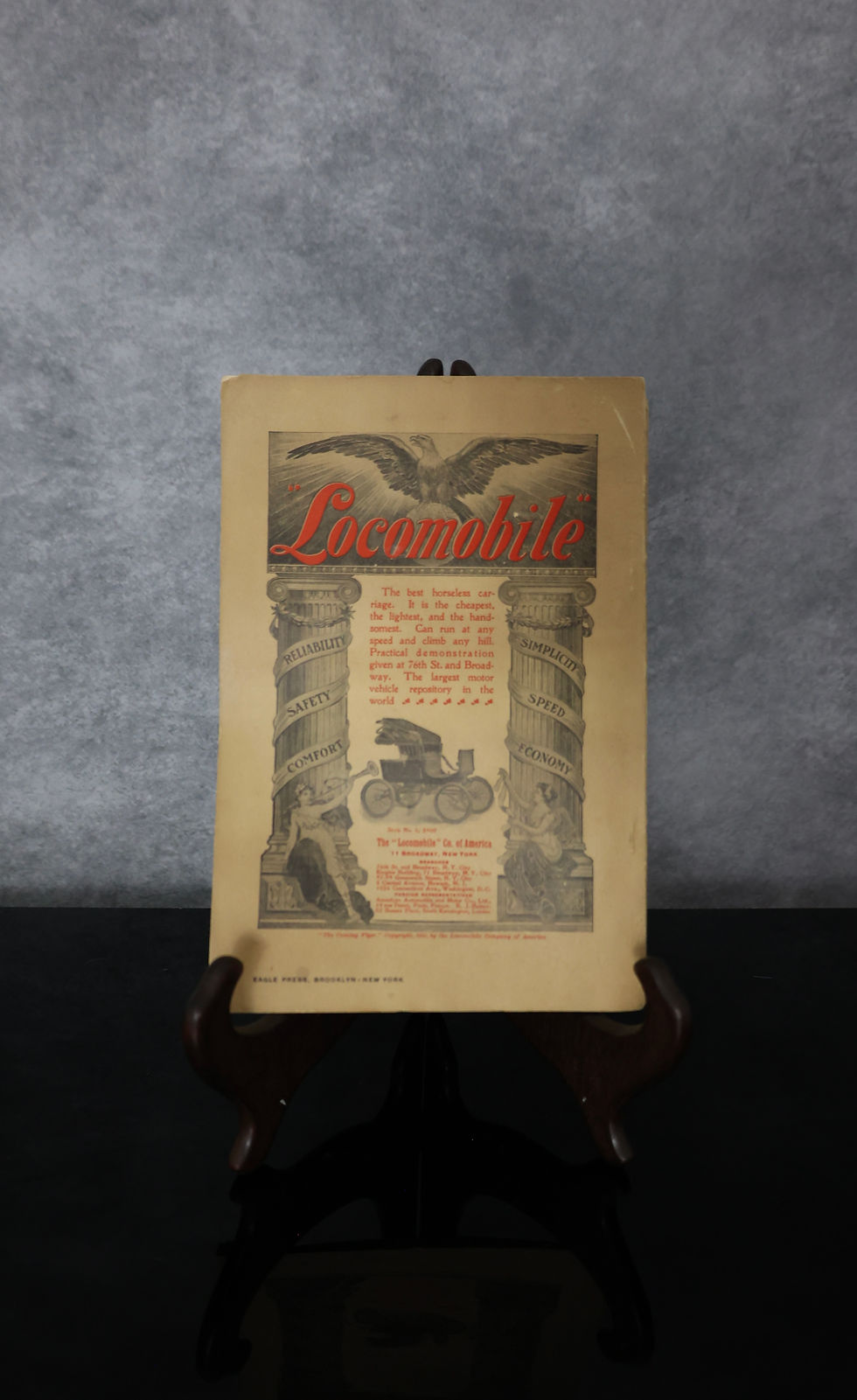
This program was produced for the Cuban Orphan Society Children's National Easter Festival, held at the Metropolitan Opera House in New York City from April 16 through April 21, 1900. The cover identifies the event as a charitable effort directed toward "The Boys and Girls of the United States to the Children of Cuba." The program was published less than two years after the conclusion of the Spanish American War in 1898 and during the period of United States military occupation of Cuba. Advertisements contained within the program include a Locomobile automobile advertisement dated May 1, 1900, further confirming the publication date and placing the object within the immediate aftermath of the conflict.
The program survives as a rare example of printed ephemera documenting how Americans interpreted and responded to Cuba's humanitarian crisis at the turn of the twentieth century.
Design, Materials, and Function
The program is printed on paper and features an elaborate Art Nouveau inspired cover design incorporating classical columns, allegorical figures, and decorative typography.
The imagery emphasizes compassion, education, and international goodwill. Children are prominently featured throughout the design, reinforcing the charitable purpose of the event.
Inside, the publication likely served multiple functions. It acted as an event guide, a fundraising tool, a commemorative souvenir, and a platform for advertisers seeking exposure among attendees.
Programs of this type were commonly distributed during charity festivals and public benefit events, helping organizers raise awareness and financial support while documenting the occasion itself.
The Spanish American War and the Origins of a New Relationship
The significance of this program extends far beyond the event it advertised.
The Spanish American War ended in 1898 with Spain relinquishing control of Cuba after nearly four centuries of colonial rule. Although Cuba formally moved toward independence, the United States remained deeply involved in Cuban affairs through military administration, economic influence, and political oversight.
This program captures a moment when many Americans viewed Cuba through a humanitarian lens. Newspapers, charities, churches, and civic organizations frequently portrayed Cuban civilians, particularly children, as victims of war who required assistance from the United States.
The language on the cover reflects that sentiment. American children were encouraged to help Cuban children through charitable giving and public participation.
At the same time, the program represents the beginning of a far more complicated relationship between the two nations. While many aid efforts were motivated by genuine compassion, they also emerged within a broader framework of American influence in Cuba. The years following the war saw growing political, economic, and military involvement by the United States, shaping Cuban affairs for decades.
As a result, this program documents both humanitarian idealism and the early stages of a relationship that would become one of the most significant and complex international relationships in the history of the Caribbean.
Children, Charity, and Public Fundraising
The late nineteenth and early twentieth centuries witnessed a dramatic expansion of organized charitable campaigns in the United States.
Public festivals, benefit concerts, exhibitions, and fundraising events became common methods for supporting disaster relief, orphanages, hospitals, and international aid efforts.
The Cuban Orphan Society emerged during a period when Americans closely followed developments in Cuba through newspapers and illustrated magazines. Reports describing the hardships faced by Cuban civilians generated widespread sympathy and encouraged charitable action.
By focusing specifically on children, organizers created a message that transcended politics and appealed directly to public emotion. The event transformed international relief into a personal and accessible cause for American families.
Advertising and Modern America
One of the most fascinating aspects of the program is its inclusion of contemporary advertising.
The Locomobile advertisement featured within the publication promotes one of the earliest American automobile manufacturers. The advertisement emphasizes reliability, safety, comfort, simplicity, speed, and economy, qualities that reflected the aspirations of the emerging automobile industry.
The presence of such advertising highlights the rapid modernization occurring in the United States around 1900. Within a single publication, readers encountered both an international humanitarian campaign and one of the newest technological innovations of the age.
This combination reflects the cultural environment of turn of the century America, where philanthropy, consumer culture, industrial progress, and international engagement increasingly intersected.
Condition and Evidence of Use
The program exhibits wear consistent with age and handling. Minor edge wear, surface toning, and light creasing are present throughout.
The printed graphics remain largely intact and continue to display the intricate design work characteristic of high quality turn of the century event publications.
These signs of wear are consistent with an object intended for temporary use that survived well beyond its original purpose.
Provenance
This program was acquired through a private sale. No documented ownership history is currently known.
Despite the absence of provenance, the printed event dates, advertisements, and organizational information provide strong evidence for attribution and historical context.
Conclusion
The Cuban Orphan Society Children's National Easter Festival program is more than a souvenir from a charitable event.
It is a document of a pivotal historical moment when the United States and Cuba entered a new phase of interaction following the Spanish American War. Through its fundraising mission, artistic design, and contemporary advertisements, the program reveals how Americans understood Cuba at the dawn of the twentieth century.
Today, the publication serves as a tangible record of humanitarian activism, public philanthropy, early automobile culture, and the beginnings of a relationship between Cuba and the United States that would shape the history of both nations for generations.
Sources
Library of Congress, Spanish American War Overview https://www.loc.gov/rr/hispanic/1898/
U.S. Department of State, Milestones in the History of U.S. Foreign Relations, The Spanish American War, 1898 https://history.state.gov/milestones/1866-1898/spanish-american-war
Library of Congress, Cuba and the United States Collection https://www.loc.gov/collections/cuba-and-the-united-states/
Smithsonian National Museum of American History, Philanthropy and Reform in America https://americanhistory.si.edu
Encyclopedia of Greater Philadelphia, Humanitarian Relief and Progressive Era Charity Movements https://philadelphiaencyclopedia.org
Locomobile Society of America, History of the Locomobile Company https://locomobile.org
The Metropolitan Opera Archives, Historical Background of the Metropolitan Opera House https://archives.metopera.org
National Archives, Records Relating to U.S. Occupation of Cuba Following the Spanish American War https://www.archives.gov/research/military/spanish-american-war


Comments