
Dairy of a Traveling Victorian Woman
- Jun 6
- 3 min read
Status: Available for Loan Consideration for exhibition, institutional study, research, or approved placement.

"A Life A Day" Personal Diary
United States
c. 1907–1910
Printed daily diary with leather or leatherette binding, gilt-stamped cover, handwritten ink entries
Dating and Identification
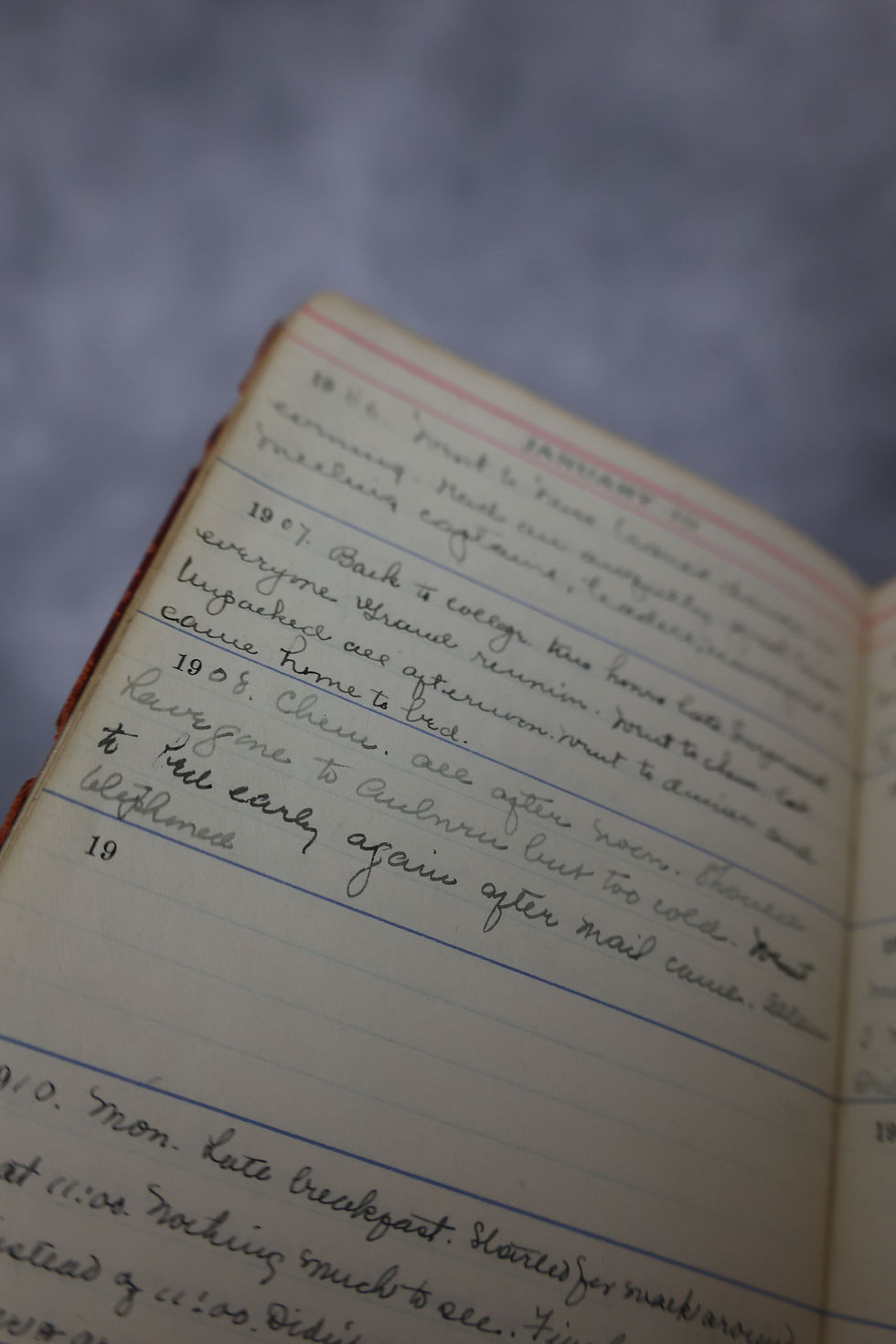
This small personal diary, titled A Life A Day, contains handwritten entries documenting daily activities between approximately 1907 and 1910. Internal inscriptions reference dates including January 1907, January 1908, January 1909, and January 1910, providing a remarkably precise chronological framework for the volume.
The format reflects the popularity of commercially produced daily diaries during the late Victorian and Edwardian periods. Designed to encourage routine record-keeping, these volumes offered dedicated space for brief daily observations, appointments, travel notes, social engagements, and personal reflections.
Unlike published histories or memoirs written years later, diaries such as this were created contemporaneously with the events they describe, making them valuable primary source documents.
Function and Use
The diary served as a personal record of everyday life. Rather than focusing on major historical events, the writer documented ordinary routines, social visits, travel, weather observations, meetings, errands, and movements between communities.
The entries reveal something often forgotten in modern discussions of the past: people were constantly moving. Family visits, train travel, local excursions, social gatherings, church activities, and regional journeys appear throughout the volume. While transportation technologies differed from those of today, mobility remained a central part of everyday life.
The diary demonstrates that early twentieth-century Americans maintained complex social networks and traveled frequently for work, education, family obligations, and leisure. The pace may have been slower, but movement was still an essential component of daily existence.
Historical Context
By the first decade of the twentieth century, railroads connected much of North America, while streetcars, ferries, horse-drawn conveyances, and emerging automobiles facilitated regional travel. Communication technologies such as telegraphs and telephones increasingly linked distant communities.
Personal diaries provide historians with evidence that complements official records. Census documents, newspapers, and government archives can tell us where people lived, but diaries reveal how they experienced everyday life.
This volume captures the ordinary rhythms of the Edwardian era, an age often remembered for its formality and social conventions. But its also characterized by increasing mobility, expanding transportation networks, and growing interconnectedness between communities.
Research Value
The greatest significance of this object lies in its status as a primary source.
Unlike reproductions, recollections, or later interpretations, the diary contains original handwritten entries created by an individual living through the period being documented. Such firsthand accounts provide direct evidence of daily experiences, language usage, social customs, travel patterns, and personal priorities.
Researchers in social history, genealogy, transportation history, women's history, local history, and material culture frequently rely upon diaries like this because they preserve information rarely recorded elsewhere.
Even seemingly mundane observations can provide valuable insight into how ordinary people understood and navigated their world.
Design and Material Culture
The diary's compact format reflects its intended portability. The red binding, decorative gilt title, and durable construction suggest a commercially produced volume designed for daily use throughout the year.
The title, A Life A Day, reflects a philosophy common among diary publishers of the era: that a life is built through the accumulation of ordinary days. While no single entry may appear historically significant on its own, together they create a rich portrait of an individual's lived experience.
The wear visible on the binding and pages demonstrates prolonged use and reinforces the diary's role as a working personal object rather than a decorative volume.

Condition
The diary exhibits expected wear consistent with age and use, including rubbing to the binding, edge wear, page discoloration, and signs of handling. Handwritten entries remain visible throughout the volume.
These condition characteristics are typical of personal diaries that were actively used and carried over multiple years.
Provenance
No provenance is currently known.
Interpretive Significance
What makes this diary particularly compelling is not a single dramatic event, but rather its cumulative portrait of everyday movement and activity. The entries challenge modern assumptions that people of the early twentieth century lived static or isolated lives. Instead, they reveal an individual actively navigating social obligations, travel, communication, and personal relationships across multiple years.
For historians, the value of the volume lies precisely in its ordinariness. It preserves moments that would otherwise have vanished entirely from the historical record.
Conclusion
A Life A Day serves as a rare firsthand window into everyday life during the Edwardian era. Through its handwritten entries, the diary documents the routines, travels, and social connections of an individual living in the first decade of the twentieth century. As a primary source, it transforms ordinary experiences into historical evidence, reminding us that the past was not inhabited by abstract historical figures, but by people whose lives were filled with movement, relationships, responsibilities, and daily decisions much like our own.
Sources
Britannica, “Diary”https://www.britannica.com/art/diary-literature
Library of Congress, “Types of Sources”https://guides.loc.gov/student-resources/types
Library of Congress, “Getting Started with Primary Sources”https://www.loc.gov/programs/teachers/getting-started-with-primary-sources/
Duke University Digital Repository, “Women’s Travel Diaries”https://repository.duke.edu/dc/womenstraveldiaries


Comments